
The absence of mint marks on one-cent coins in 1967 results from implementing the provisions of the Coinage Act of July 23, 1965.
President Lyndon B. Johnson signed this document responding to an acute shortage of small change in the US economy.
The US Treasury Department blamed private individuals for the coin shortage, accusing them of removing new mintages from circulation to create numismatic collections.
To combat this phenomenon, the government introduced a temporary ban on using letter designations for minting locations.
This measure remained in effect from 1965 through 1967 inclusive.
Minting 1967 penny no mint mark coins aimed at creating a uniform mass of currency, being deprived of collector appeal based on the production site.
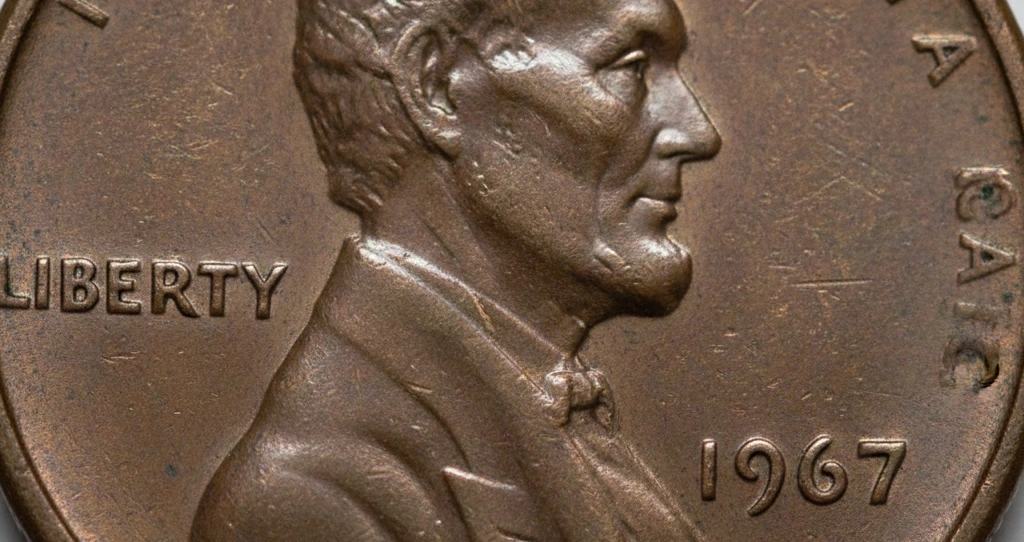
Distribution of Mintage Between Mints
Despite the visual identity of all 1967 coins, their production was distributed among three state facilities.
Since the marks of distinction were absent, identifying the specific minting location for an individual coin remains technically impossible without the original bank packaging.
Mint | Location | Mintage Volume (1967 Cents) |
Philadelphia | Pennsylvania | 907,575,000 |
Denver | Colorado | 1,327,377,100 |
San Francisco | California | 813,715,000 |
The total production volume exceeded 3 billion specimens, recording one of the most massive releases in the history of the Lincoln series.
San Francisco, having resumed work on minting coins for circulation after a ten-year hiatus, also did not use the "S" mark in accordance with current legislation.
Technical Rationale for Uniformity
Using identical working dies without mint marks allowed the US Treasury to accelerate production processes.
Eliminating the stage of adding a letter to the master die simplified logistics between enterprises.
This decision ensured the interchangeability of equipment, allowing for the transfer of capacities to areas showing the highest demand for cash.
Coins from 1967 struck in Denver are technically no different from coins from Philadelphia, having identical chemical composition and mass.
Numismatic Classification and Color Grading
The absence of a mint mark makes surface condition the sole factor determining the market value of the asset.
Numismatists classify these coins with the coin value checker app according to the degree of preservation of natural copper luster.
Brown (BN): Specimens with a completely oxidized surface.
This category constitutes 98% of the entire surviving volume of 1967 coins.Red-Brown (RB): Coins retaining fragments of the original color.
The value of RB samples in MS64 preservation ranges from 2 to 8 dollars.Red (RD): Fully luster-preserved specimens.
The price of RD coins grows exponentially when transitioning from MS65 to MS67 grade.
Auction Statistics for 1967 Cents
The market for 1967 coins is characterized by high volatility in the upper preservation segments.
For ordinary specimens from circulation, the price is fixed at face value or the metal's cost (approximately 2.8 cents for copper).
Below are the data for record sales of certified specimens.
PCGS MS67 RD: In 2013, the lot sold for 646 US dollars.
PCGS MS67 RD: In 2019, the price for the same grade decreased to 430 US dollars, demonstrating a 33% drop over 6 years.
PCGS MS67+ RD: An exceptional specimen realized in 2019 for 5,500 US dollars.
Statistics show that the annual increase in the number of coins in MS66 RD grade is approximately 4%, reducing the scarcity of this position.
In the MS67+ RD category, new entries are recorded less than once every two years, providing price stability for investors.
Special Mint Sets (SMS) 1967
Due to the cancellation of mint marks and Proof sets, the Mint produced special SMS sets.
These coins were struck on polished planchets using high-pressure dies.
SMS Characteristic | Value |
Set Mintage | 2,261,583 units |
Alloy Composition | 95% Cu, 5% Zn |
Record SP68 DCAM | $4,025 (Year 2004) |
Average Price SP67 RD | $15 - $22 |
The absence of a mark on coins from these sets also complies with the 1965 law.
Influence of Copper Composition on Value
The 1967 cents contain 95% copper, differing from modern zinc counterparts produced after 1982.
The metal value (melt value) serves as the basic financial threshold for this coin.
With a 10% rise in copper prices, the intrinsic value of the coin increases proportionally, creating conditions for mass melting.
US law prohibits the export and melting of cents for commercial purposes, imposing restrictions on metal realization.
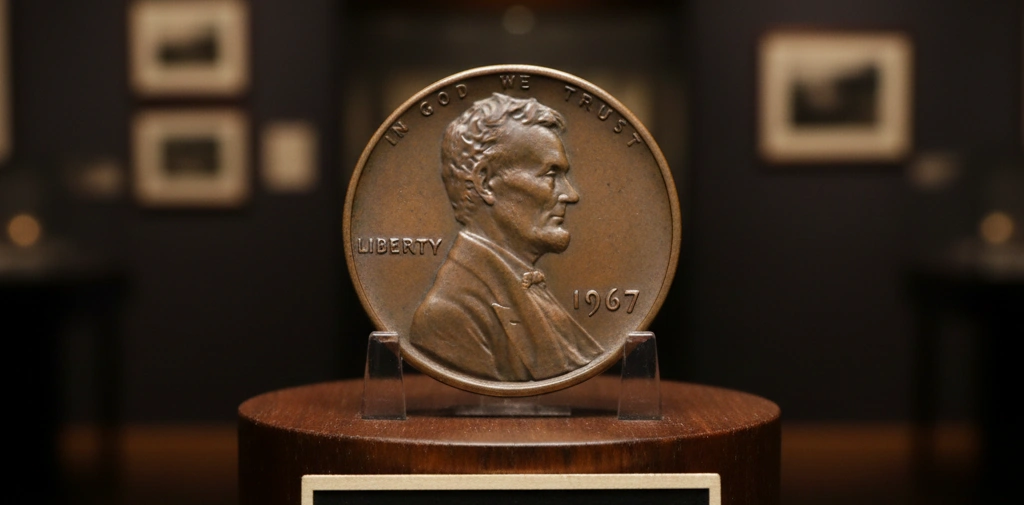
Minting Errors in Mass Production Conditions
The absence of a mint mark is not an error, being the standard execution for 1967.
However, technological deviations having a confirmed value were recorded during this period.
Double Struck: The value ranges from 150 to 350 dollars while retaining the date.
Struck on a 10-cent Planchet: An extremely rare defect valued at 1,000 – 1,500 dollars.
Die Crack: A common flaw adding 5 to 20 dollars to the price.
Statistical distribution of errors shows that 1967 has 12% more minor defects compared to 1964 due to the forced pace of equipment operation.
Market Dynamics and Liquidity
Liquidity for 1967 coins without a mint mark is distributed unevenly.
Specimens in condition below MS65 RD have extremely low liquidity, being traded in bulk lots by weight.
The market for high-quality MS67 RD coins is supported exclusively by a coin identifier app, PCGS, and NGC registries.
Analysis of data over the last 10 years revealed the following pattern.
Prices for MS65 RD coins fell by 15% due to market oversaturation.
The MS67 RD segment demonstrates stagnation with annual price fluctuations within 2–3%.
Demand for rare minting errors grew by 20% over the last 5 years, outpacing the rise in metal value.
Factors Determining Preservation
Copper coins from 1967 are extremely sensitive to environmental conditions.
The lack of protective coating on coins for circulation leads to a rapid loss of "Red" (RD) status.
Storing coins in paper rolls for 50 years often results in the appearance of patina, moving the coin to the BN category.
This process is irreversible, depriving the coin of 90% of its potential numismatic value.
Comparison with the 1968 Issue
In 1968, the use of mint marks was restored.
A comparison of the 1967 (no mark) and 1968 (with D and S marks) mintages shows a recovery of interest in numismatics.
The 1968-S mintage was only 258 million, being three times smaller than the 1967 San Francisco release.
This makes the 1967 cent less scarce in quantitative terms but more complex regarding the identification of the place of origin.